Where your audience buys your tickets.
What does a ticketing system cost? Four pricing models explained
A ticketing system charges a fixed amount, a percentage, a service fee to your visitor or a subscription. How to compare them fairly, with worked examples and the costs that are not in the rate.
 Henrico Pops •
Updated on 10 September 2026.
A ticketing system costs you money in one of four ways: a fixed amount per ticket, a percentage plus a fixed amount, a service fee your visitor pays, or a subscription. Which model is cheapest depends on your ticket price, your numbers and who gets the bill. You compare them with one number: what a ticket sold costs you at your own average ticket price.
The four pricing models
A fixed amount per ticket sold
You pay the same amount per ticket sold, whether the ticket costs €5 or €50. That makes budgeting simple: sell 400 tickets and you know the cost in advance. Tickable works this way, at €0.32 per ticket; Ticketkantoor charges €0.66, both excluding VAT.
A percentage plus a fixed amount
A share of your ticket price, usually a few percent, with a fixed amount per ticket on top. On cheap tickets that is modest; on more expensive ones it adds up, while the platform does nothing different for a €50 ticket than for a €10 one. Fairtix quotes from €0.49 per ticket plus 2.9% transaction costs on its own site.
A service fee for your visitor
The platform calls itself free for the organiser and charges its costs to the buyer as a service or booking fee. You see no invoice, but your ticket becomes more expensive. Weeztix charges €0.83 per ticket excluding VAT this way for paid events in the Netherlands up to 5,000 tickets a year; Ik Ben Aanwezig €0.79 per ticket including VAT.
A subscription
A fixed amount per month or year, with low or no costs per ticket. That pays off at a large, regular volume, such as a venue that sells every week. If you organise something once or twice a year, you mostly pay for months in which nothing is sold.
We checked the rates above with the providers themselves on 9 September 2026. Every system with its current rate is in our overview of ticketing systems.
What it costs at your ticket price
The difference between the models only shows when you put them side by side at different ticket prices. Two fixed amounts and a percentage model, per ticket sold and excluding VAT:
| Ticket price | Fixed €0.32 | Fixed €0.80 | 3% plus €0.80 |
|---|---|---|---|
| €10 | €0.32 | €0.80 | €1.10 |
| €25 | €0.32 | €0.80 | €1.55 |
| €50 | €0.32 | €0.80 | €2.30 |
| 500 tickets at €25 | €160 | €400 | €775 |
€2.30
What a 3% plus €0.80 model costs on a single €50 ticket. With a fixed amount it stays the same, however expensive your ticket.
Who pays: you or your visitor
With a service fee your visitor pays, and to you that feels free. The difference is in what your audience sees. Under Dutch consumer rules (ACM), unavoidable costs must already be in the first price you show, so a €15 ticket with a €1.25 service fee is advertised as €16.25. The amount does not disappear, it just sits in your price, and you cannot lower that price without giving something up yourself.
Unexpected costs in the final step are also a well-known reason to abandon an order. How that works out for a €15 ticket is worked through in where your ticket price goes (in Dutch).
Costs that are not in the rate
A rate per ticket is rarely the whole story. Also ask about:
- Transaction costs per payment method. For iDEAL you usually pay a fixed amount per payment, for example €0.29; for cards often a percentage. Some systems include those costs in their rate, but only for iDEAL and Bancontact.
- Refunds. If you cancel an event or refund someone, many systems do not return the platform and transaction costs.
- Free tickets. Some systems charge even for a €0 ticket, or above a certain number.
- When you are paid out. Do you get your money after the event or during the sale? That decides whether you can pay the venue and the technical crew from your pre-sale.
- Features in a more expensive plan. A seating plan, your own branding or multiple users sometimes only come with a higher subscription.
When "free" is not free
A ticketing system needs a revenue model to keep going. If it calls itself free, the model is usually one of these four:
- Free tickets are free, paid ones are not. Handy if you only run free events, but the rate for paid tickets can be high.
- Free for the organiser. The costs go to your visitor as a service fee.
- Your visitors as the product. The platform uses your audience's data for its own marketing or advertising.
- Free with limits. A basic version in which the feature you need sits in the paid plan.
How to compare in three steps
- Work out for each system what one ticket sold costs at your average ticket price, including transaction costs.
- Check who pays. Add any service fee for your visitor to the price they see, and ask whether your audience will accept that price.
- Go through the extra costs: refunds, free tickets, payout and the features you need.
At Tickable we keep it to a fixed amount: €0.32 per ticket sold, excluding VAT, with no subscription, no transaction costs on top and no service fee for your visitor. See our pricing.
Frequently asked questions
What does a ticketing system cost per ticket?
With a fixed amount, usually between €0.30 and €1 per ticket. With a percentage model it depends on your ticket price. With Tickable €0.32 per ticket sold, excluding VAT.
Is a percentage or a fixed amount cheaper?
On cheap tickets a percentage can be modest. The more expensive your ticket, the better a fixed amount works out. Work it out at your own ticket price.
May I pass a service fee on to my visitor?
Yes, but under Dutch consumer rules (ACM) unavoidable costs must be in the first price you show. You then advertise the price including the service fee.
What does a free ticket cost?
With Tickable, nothing. With other systems it varies: some charge for free tickets too, or above a certain number per year.
Sources: ACM, price display for concert, theatre and festival tickets · provider rates checked on 9 September 2026, see our overview of ticketing systems

Experience the benefits of a ticketing platform
Join 540+ event organisers using Tickable for their ticket sales and visitor management.
Get startedMore from Tickable
How can I sell tickets online with iDEAL?
Guide to selling tickets with iDEAL via Tickable, benefits, PSP integrations (Mollie, Stripe, MultiSafepay), tips, and frequently asked questions.
Read more
Sell tickets online with Mollie
Connect your own Mollie account to Tickable for more control, direct payouts, and discounts, or use integrated payments with zero setup.
Read more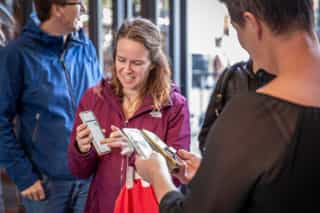
Port Wine Festival Zwolle sells 600+ tickets online with Tickable
Discover how the first Port Wine Festival Zwolle sold 600+ tickets with early bird offers, masterclass tickets, and lightning-fast check-ins via Tickable.
Read more